Comparing Messaging App Security Features: Top Platforms Reviewed

Messaging app security features are critical for protecting digital communications, encompassing end-to-end encryption, data retention policies, and user privacy controls to ensure robust protection against unauthorized access.
In today’s interconnected world, where digital communication is paramount, understanding and comparing messaging app security features: which platforms offer strong protection? is no longer just a technical curiosity but a fundamental necessity. Our personal and professional lives increasingly unfold across these platforms, making the security of our conversations a top priority. This guide aims to demystify the complex world of messaging app security, offering clear insights into what truly keeps your messages safe.
Understanding End-to-End Encryption (E2EE)
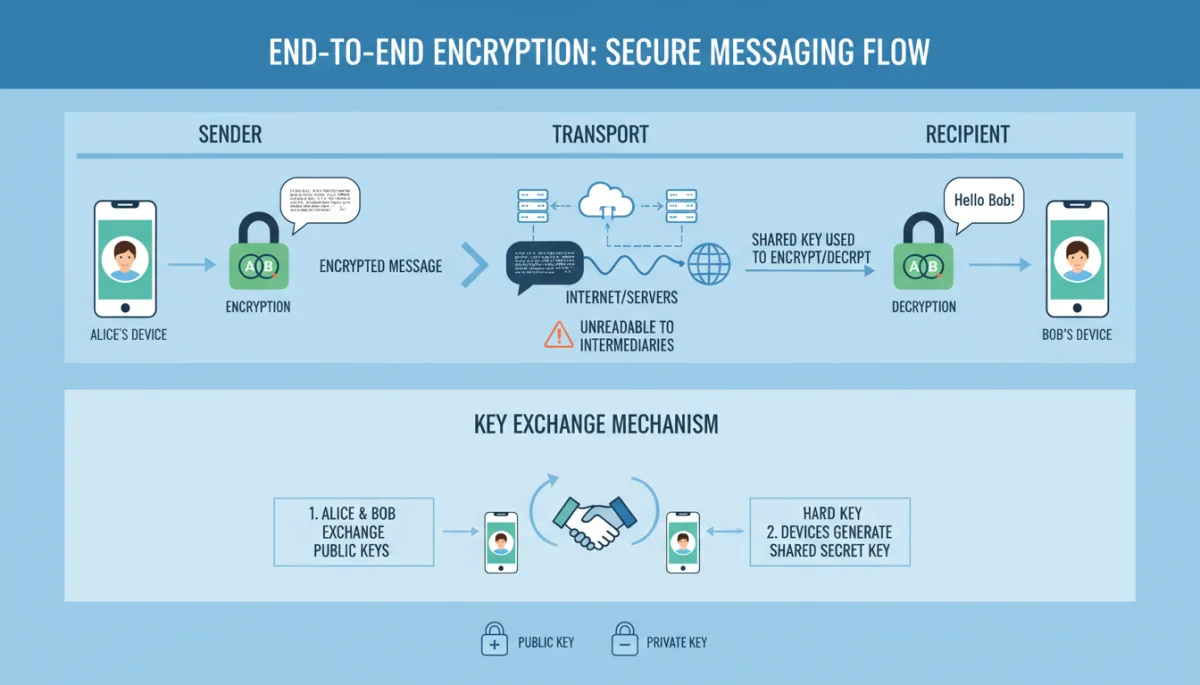
End-to-end encryption (E2EE) stands as the cornerstone of secure messaging. It ensures that only the sender and the intended recipient can read messages, preventing even the service provider from accessing the content. This fundamental technology transforms your messages into an unreadable format from the moment they leave your device until they reach their destination.
When evaluating messaging apps, the implementation of E2EE is a primary factor. Not all E2EE is created equal, and understanding its nuances is crucial for truly secure communication. A robust E2EE protocol means your data is encrypted at the source and remains encrypted across all transit points, only to be decrypted by the recipient’s device.
How E2EE Works in Practice
The process of end-to-end encryption involves complex cryptographic keys. Each user has a pair of keys: a public key and a private key. When you send a message, it’s encrypted using the recipient’s public key, which is openly shared. Only the recipient’s private key, held securely on their device, can decrypt the message. This ensures that even if a message is intercepted, it remains indecipherable without the correct private key.
- Key Exchange: Secure methods for exchanging public keys are vital to prevent man-in-the-middle attacks.
- Algorithm Strength: The cryptographic algorithms used (e.g., AES-256, Signal Protocol) determine the strength of the encryption.
- Forward Secrecy: This feature ensures that if a private key is compromised, past communications remain secure.
The strength of E2EE greatly depends on its implementation. Some apps offer E2EE by default for all communications, while others require users to enable it manually or only offer it for specific types of chats. This distinction is critical for users seeking maximum privacy.
Challenges and Limitations of E2EE
Despite its robustness, E2EE is not without its challenges. The primary limitation often lies in metadata. While message content is encrypted, information such as who messaged whom, when, and from where (metadata) may still be accessible to service providers. This data can sometimes be used to infer patterns or relationships, even without accessing the message content.
- Metadata Collection: Apps vary widely in the amount and type of metadata they collect.
- Backup Security: Cloud backups of chats can sometimes bypass E2EE if not handled securely by the app or user.
- User Error: Weak passwords, compromised devices, or social engineering can undermine even the strongest encryption.
A comprehensive understanding of E2EE allows users to appreciate its power while also being aware of its limitations. It’s a powerful tool, but it’s part of a larger security ecosystem that includes user behavior and app-specific policies.
In conclusion, E2EE is a critical component for secure messaging, providing a high level of confidentiality for message content. However, users must also consider how apps handle metadata and backups, as well as their own security practices, to achieve truly comprehensive protection.
Privacy Policies and Data Handling Practices
Beyond encryption, an app’s privacy policy and its approach to data handling are crucial indicators of its overall security posture. These documents outline what data the app collects, how it’s used, stored, and shared, and under what circumstances. A transparent and user-centric privacy policy is a hallmark of a trustworthy messaging platform.
Understanding these policies requires careful reading, as they often contain legal jargon. However, focusing on key areas like data retention, third-party sharing, and government requests can provide a clear picture of the app’s commitment to user privacy.
Data Collection and Retention
Different messaging apps have vastly different approaches to data collection. Some aim to collect as little user data as possible, while others gather extensive information for various purposes, including advertising or service improvement. Data retention policies specify how long this collected data is kept.
- Minimal Data Collection: Apps that collect minimal data inherently reduce the risk of data breaches or misuse.
- Ephemeral Messaging: Features like disappearing messages can help reduce data retention on servers and devices.
- Data Localization: Where data is stored can impact its legal protection, depending on the jurisdiction.
Apps that prioritize user privacy often have strong stances against retaining message content or extensive metadata. They understand that less data collected means less data to potentially compromise.
Third-Party Sharing and Government Requests
A significant aspect of privacy policies is how apps handle sharing data with third parties, including advertisers, partners, or government agencies. Some apps explicitly state they do not share user data, while others may have provisions for sharing under specific legal circumstances.
- Transparency Reports: Some companies publish reports detailing government requests for user data, offering insights into their compliance.
- Warrant Canary: A warrant canary is a statement that is removed if a specific type of legal request (like a national security letter) has been received, signaling a lack of transparency.
- Adherence to GDPR/CCPA: Compliance with strict data protection regulations like GDPR (Europe) and CCPA (California) indicates a higher commitment to user privacy.
Users should be wary of apps that have vague policies regarding data sharing or a history of privacy controversies. The legal framework under which an app operates also plays a significant role in how it can be compelled to share data.
In summary, a thorough review of privacy policies and data handling practices is essential when comparing messaging app security features. It reveals the app’s true commitment to protecting user information beyond just encryption.
Advanced Security Features and Controls
Beyond the foundational E2EE and privacy policies, many messaging apps offer a suite of advanced security features designed to give users more control over their privacy and enhance overall protection. These features range from two-factor authentication to self-destructing messages, adding multiple layers of defense.
These additional controls empower users to tailor their security posture to their specific needs and risk tolerance. Understanding and utilizing these features can significantly bolster the security of your communications.
Two-Factor Authentication (2FA) and Device Management
Two-factor authentication (2FA) is a critical security layer that prevents unauthorized access to your account even if your password is compromised. It typically involves a second verification step, such as a code sent to your phone or a biometric scan.
- Strong 2FA Options: Look for apps that offer robust 2FA, including authenticator apps or hardware keys, not just SMS codes.
- Device Linking and Management: The ability to review and revoke access from linked devices is crucial for maintaining control over your account.
- Login Alerts: Notifications for new logins or suspicious activity can alert you to potential breaches early.
Effective device management ensures that only authorized devices can access your messaging account, minimizing the risk of unauthorized access due to lost or stolen devices.
Disappearing Messages and Screenshot Protection
Features like disappearing messages (also known as ephemeral messaging) allow users to set a timer for messages to automatically delete after being viewed. This helps reduce the digital footprint of conversations.
- Configurable Timers: Flexible options for message expiry, from seconds to days.
- Screenshot Notifications: Some apps notify senders if a recipient takes a screenshot of a disappearing message, adding a layer of accountability.
- Forwarding Restrictions: Preventing messages from being forwarded or copied enhances their ephemeral nature.
While not foolproof, these features contribute significantly to privacy, particularly for sensitive discussions. They reflect an app’s commitment to giving users fine-grained control over their communication’s lifespan.
In essence, advanced security features and controls are vital additions to the core security offerings of any messaging app. They provide users with the tools to proactively manage their privacy and protect their data.
Audits, Open Source, and Transparency
The credibility of a messaging app’s security claims often hinges on its willingness to undergo independent security audits, make its code open source, and maintain transparency about its practices. These elements provide external validation and allow the wider security community to scrutinize and verify claims.
Transparency builds trust, and in the realm of digital security, trust is paramount. Without it, users are left to blindly accept an app’s assurances, which can be a risky proposition.
Independent Security Audits
Independent security audits involve third-party experts rigorously examining an app’s code and infrastructure for vulnerabilities. These audits can identify weaknesses that might otherwise go unnoticed, providing an unbiased assessment of the app’s security posture.
- Regular Audits: Apps that undergo frequent audits demonstrate a proactive approach to security.
- Public Reports: The publication of audit reports allows users to review findings and verify claims.
- Bug Bounty Programs: Offering rewards to security researchers for finding and reporting vulnerabilities encourages responsible disclosure.
An app’s commitment to regular, public security audits is a strong indicator of its dedication to maintaining a secure platform.
Open-Source Code and Community Scrutiny
Open-source messaging apps make their underlying code publicly available, allowing anyone to inspect it for backdoors, vulnerabilities, or malicious intent. This peer review process significantly enhances trust and security.
- Community Contributions: Open-source projects often benefit from a global community of developers who contribute to their security and improvement.
- Reproducible Builds: The ability for users to verify that the app they download matches the open-source code ensures integrity.
- Transparency of Development: Open-source development processes are often transparent, allowing users to track changes and discussions.
While open source doesn’t automatically guarantee security, it fosters an environment of transparency and collective responsibility that proprietary software often lacks.
Transparency and Communication
Beyond code and audits, an app’s overall transparency in communicating with its users about security incidents, policy changes, and technical details is vital. Clear and honest communication builds and maintains user trust.
- Clear Documentation: Easy-to-understand explanations of security features and protocols.
- Prompt Incident Response: How an app handles security breaches or vulnerabilities, including timely disclosure and mitigation.
- Developer Engagement: Active participation by developers in security forums and discussions.
An app that is open about its security practices, even when facing challenges, demonstrates a higher level of integrity and commitment to its users’ protection.
Comparing Leading Messaging Apps: A Security Overview
When it comes to comparing messaging app security features: which platforms offer strong protection?, a direct look at the leading contenders is essential. Each popular app brings its own set of security strengths and weaknesses, making the choice often dependent on individual priorities and threat models.
This overview provides a snapshot of how some of the most widely used messaging apps stack up in terms of their security offerings, focusing on their core features and known practices.
Signal: The Gold Standard for Privacy
Signal is widely regarded as the benchmark for secure messaging. It uses the Signal Protocol, an open-source, peer-reviewed cryptographic protocol, for all communications, including one-on-one messages, group chats, voice calls, and video calls. E2EE is enabled by default for everything.
- Default E2EE: All communications are end-to-end encrypted by default.
- Minimal Metadata: Signal collects almost no user metadata, focusing solely on the information necessary to operate the service.
- Open Source: Signal’s code is open source, allowing for public scrutiny.
- Independent Audits: Regularly undergoes security audits.
Signal’s commitment to privacy extends to features like disappearing messages, screen security (preventing screenshots in the app), and registration without linking to a phone number (using a secure PIN). It’s an excellent choice for those prioritizing maximum privacy.
WhatsApp: Widespread E2EE, but Data Concerns
WhatsApp, owned by Meta (formerly Facebook), also utilizes the Signal Protocol for its end-to-end encryption. This means that individual and group chats are generally secure in terms of content. However, its association with Meta raises significant privacy concerns for many users.
- Signal Protocol E2EE: Secure content encryption for messages and calls.
- Metadata Collection: WhatsApp collects a considerable amount of metadata, which can be shared with Meta’s other services.
- Cloud Backups: While E2EE, chat backups to Google Drive or iCloud are not encrypted by WhatsApp, relying on the cloud provider’s security.
- Proprietary Code: The app’s client-side code is not open source.
While WhatsApp offers strong message content security, its extensive metadata collection and integration with Meta’s ecosystem are significant drawbacks for privacy-conscious individuals.
Telegram: Strong Encryption, But Not Always Default
Telegram offers a unique approach to security. While it boasts strong encryption, its end-to-end encryption (called ‘Secret Chats’) is not enabled by default for all conversations. Regular cloud chats are encrypted client-to-server, but not end-to-end.
- Secret Chats (E2EE): Offer E2EE, disappearing messages, and screenshot prevention.
- Cloud Chats (Client-to-Server Encryption): Messages are stored on Telegram’s servers and can be accessed by Telegram.
- Proprietary MTProto Protocol: Telegram uses its own custom encryption protocol, which some cryptographers view with skepticism compared to widely peer-reviewed protocols like Signal.
- Metadata: Collects more metadata than Signal.
Telegram is popular for its large group chat features and channels, but users must actively choose ‘Secret Chats’ for true end-to-end encrypted communication. This distinction is crucial for understanding its security posture.
Other Contenders: Threema, Session, and Element
- Threema: A paid app focusing on maximum privacy. It offers E2EE for all communications, does not require a phone number, and keeps metadata to a minimum. It’s based in Switzerland, known for strong privacy laws.
- Session: Built on the Onion Routing network (similar to Tor), Session offers anonymous messaging without phone numbers or email addresses. All messages are E2EE and routed through a decentralized network.
- Element (Matrix): An open-source, decentralized communication platform that offers E2EE for all direct messages and group chats. Its decentralized nature means no single entity controls your data, offering high levels of sovereignty.
Each of these alternatives caters to users with specific privacy needs, often providing features that go beyond what mainstream apps offer.
In conclusion, the best messaging app for security depends on a user’s specific needs. Signal consistently leads in privacy and security, while others like WhatsApp offer E2EE with trade-offs. Exploring alternatives like Threema or Session can provide even greater control and anonymity.
User Behavior and Security Best Practices
Even the most secure messaging app can be compromised by poor user behavior. Ultimately, the human element is often the weakest link in any security chain. Adopting robust security best practices is as crucial as choosing a secure platform when comparing messaging app security features: which platforms offer strong protection?
Empowering yourself with knowledge and implementing simple yet effective habits can significantly elevate your digital communication security.
Strong Passwords and PINs
Your account’s primary defense often starts with a strong, unique password or PIN. Reusing passwords across different services or using easily guessable combinations makes you vulnerable to various attacks.
- Password Managers: Utilize password managers to generate and store complex, unique passwords for all your accounts.
- Unique PINs: If an app offers a secure PIN (like Signal), ensure it’s distinct from any other PINs you use.
- Regular Updates: Change your passwords periodically, especially if there’s any suspicion of compromise.
A compromised password can grant unauthorized access to your messages, bypassing even the strongest encryption protocols.
Enabling Two-Factor Authentication (2FA)
As discussed earlier, 2FA adds a critical layer of security. Always enable it wherever available, especially for your messaging apps and associated email accounts.
- Authenticator Apps: Prefer authenticator apps (e.g., Authy, Google Authenticator) over SMS-based 2FA, as SMS can be vulnerable to SIM-swapping attacks.
- Hardware Keys: For the highest level of security, consider using hardware security keys (e.g., YubiKey) if supported.
- Recovery Codes: Store recovery codes for your 2FA in a secure, offline location.
Enabling 2FA makes it significantly harder for attackers to gain access to your account, even if they manage to steal your password.
Device Security and Software Updates
The security of your messaging app is intrinsically linked to the security of the device it’s running on. An unsecured phone or computer can expose your communications.
- Keep Software Updated: Regularly update your operating system and all apps to patch known security vulnerabilities.
- Strong Device Passwords: Use a strong PIN, password, or biometric lock for your device.
- Beware of Phishing: Be cautious of suspicious links or messages that could lead to malware or credential theft.
- Secure Wi-Fi: Avoid using public, unsecured Wi-Fi networks for sensitive communications.
Maintaining a secure device environment is paramount. A phone infected with malware could potentially expose your messages before they are encrypted or after they are decrypted.
In conclusion, while choosing a secure messaging app is a vital first step, active user participation through strong security practices is equally important. Your digital security is a shared responsibility between the app provider and you.
The Future of Messaging App Security
The landscape of messaging app security is constantly evolving, driven by advancements in cryptography, new regulatory pressures, and the ever-present threat of sophisticated cyberattacks. Understanding these trends helps us anticipate the future of secure communication and stay ahead of emerging risks.
Innovation in this space is rapid, with developers continually seeking to enhance privacy and security without compromising usability.
Post-Quantum Cryptography
One of the most significant long-term challenges is the advent of quantum computing. While still in its early stages, quantum computers could theoretically break many of the encryption algorithms used today. Researchers are actively developing post-quantum cryptography (PQC) to prepare for this future.
- Quantum-Resistant Algorithms: Development of new cryptographic algorithms designed to withstand quantum attacks.
- Standardization Efforts: Organizations like NIST are working to standardize PQC algorithms.
- Early Adoption: Some forward-thinking messaging apps may begin to integrate PQC elements as they become more mature.
The transition to PQC will be a complex but necessary undertaking to ensure long-term confidentiality of digital communications.
Decentralized Messaging and Blockchain
Decentralized messaging platforms, often utilizing blockchain technology, offer an alternative model to traditional centralized services. By distributing data across a network, they aim to eliminate single points of failure and enhance censorship resistance.
- Enhanced Resilience: Decentralized networks are less susceptible to server outages or government shutdowns.
- User Sovereignty: Users often have greater control over their data and identities.
- Privacy by Design: Many decentralized platforms are built with privacy as a core principle.
While still facing challenges in terms of scalability and user adoption, decentralized messaging holds promise for a more resilient and private communication future.
Regulatory Landscape and Privacy Laws
Governments worldwide are increasingly grappling with how to regulate messaging apps, balancing national security concerns with individual privacy rights. This can lead to pressures on app developers to implement backdoors or weaken encryption.
- Evolving Legislation: New laws like the EU’s Digital Services Act (DSA) and discussions around ‘lawful access’ to encrypted communications.
- Impact on E2EE: Potential for legislative efforts to undermine end-to-end encryption.
- Global Differences: Varying legal frameworks across countries create a complex environment for global messaging services.
The ongoing tension between privacy and surveillance will continue to shape the development and deployment of secure messaging technologies. Users must remain vigilant and advocate for strong privacy protections.
In conclusion, the future of messaging app security is dynamic and challenging. From preparing for quantum threats to navigating regulatory landscapes, continuous innovation and user awareness will be key to maintaining secure digital communications.
| Key Security Feature | Description & Importance |
|---|---|
| End-to-End Encryption (E2EE) | Ensures messages are private between sender and receiver, unreadable by the app provider or third parties. Crucial for content confidentiality. |
| Privacy Policy & Data Handling | Outlines what user data is collected, how it’s used, stored, and shared. A transparent policy minimizing data collection is vital for privacy. |
| Two-Factor Authentication (2FA) | Adds an extra layer of security, requiring a second verification step beyond just a password to access the account. Essential for account protection. |
| Open Source & Audits | Publicly available code and independent security reviews build trust and allow for community scrutiny, validating security claims. |
Frequently Asked Questions About Messaging App Security
End-to-end encryption (E2EE) ensures that only the sender and recipient can read messages. It’s crucial because it prevents third parties, including the app provider, from accessing your communication content, thereby safeguarding your privacy from surveillance and data breaches.
Many popular apps like Signal and WhatsApp offer E2EE by default for all chats. However, some, like Telegram, only offer it in specific ‘Secret Chats,’ meaning regular conversations are not end-to-end encrypted. Always check an app’s specific implementation.
Privacy policies detail what data an app collects, how it’s used, stored, and shared. They are vital for understanding an app’s commitment to privacy beyond encryption, revealing practices regarding metadata, third-party sharing, and government requests for user data.
Beyond choosing a secure app, enable two-factor authentication, use strong and unique passwords, keep your device and apps updated, and be wary of phishing attempts. These practices significantly reduce your vulnerability to unauthorized access.
Open-source apps allow public scrutiny of their code, which can help identify vulnerabilities. While not a guarantee, this transparency fosters trust and often leads to more robust security through community review and contributions, making them generally preferred by security experts.
Conclusion
Navigating the complex world of messaging app security is a continuous journey, but an informed approach is your best defense. By prioritizing end-to-end encryption, scrutinizing privacy policies, leveraging advanced security features, and practicing good digital hygiene, you can significantly enhance the protection of your digital communications. The choice of which platform offers strong protection ultimately rests on your individual needs and vigilance, ensuring your conversations remain private and secure in an increasingly interconnected world.
